
Inefficient collection, processing and management of solid waste in Indian cities are resulting in significant avoidable GHG emissions and also lead to contamination of natural resources. Cities should adopt sustainable waste management practices by involving the community in segregation, by enforcing better public private partnership contracts, by investing in modern technology and by recognizing the role of waste pickers/ informal sectors in solid waste management.
The CapaCITIES project is supporting Indian cities in mitigating emissions from solid waste management and improving service delivery:
Developed roadmap for holistic solid waste management strategy for Coimbatore city up to 2035
- Implemented a decentralized Solid Waste Management system in Zero Waste wards (SUNYA) project in 2 wards of Coimbatore and Udaipur city, and installed waste to bio-methanation pilot projects in Coimbatore (1.5 TPD) and Udaipur (2 TPD)
- Developed financial models for e-waste collection center and for operation and maintenance of micro composting centers in Coimbatore
- In Phase 2, the project is actively engaging with Coimbatore city to develop a bankable project of converting organic waste to Bio CNG through private sector participation
Implementation Projects
Quick-win / Co-financing Projects
Decentralized Solid Waste Management System at Selected Wards

Coimbatore: CapaCITIES project team implemented the SUNYA – Zero Waste Wards initiative in ward no. 22 and 24 of Coimbatore which successfully achieved 100% household level source segregation of biodegradable waste.
In ward 22, a decentralized 1.5 tonnes per day (TPD) biomethanation plant was installed under the CapaCITIES project as a demonstration project on decentralized solid waste management that the city can replicate across the city. The biomethanation plant has the capacity to reduce 1500 tonnes of CO2e GHG emissions per annum.
Status: Completed in Phase 1
Sector: Solid Waste Management

Siliguri: CapaCITIES project team implemented the SUNYA – Zero Waste Wards initiative in ward no. 2 and 17 of Siliguri which successfully achieved household level source segregation of biodegradable waste.
Approximately 7,500 households and commercial entities in the wards. The most efficient way to reduce GHG emissions from waste disposal is to reduce waste generation at the source, followed by appropriate processing and scientific disposal of rejected waste. A decentralized 1 TPD micro-composting centre was designed and installed under the project to process biodegradable waste from the two wards which can reduce around 2500 tCO2e of GHG emissions.
Status: Completed in Phase 1
Sector: Solid Waste Management

Udaipur: CapaCITIES project team implemented the SUNYA – Zero Waste Wards initiative in ward no. 1 and 41 of Udaipur which successfully achieved household level source segregation of biodegradable waste.
Approximately 3500 households and commercial entities were initiated to waste segregation practices on a pilot scale. Based on a quantification and characterization study of waste from the two wards, a decentralized 2 TPD biomethanation plant was designed and installed to process the 2.65 tonnes of mixed waste generated daily from the two wards. The annual GHG emission mitigation potential of the is 1,437 tCO2e.
Status: Completed in Phase 1
Sector: Solid Waste Management
Bankable Projects
E-Waste Management Initiated in Coimbatore

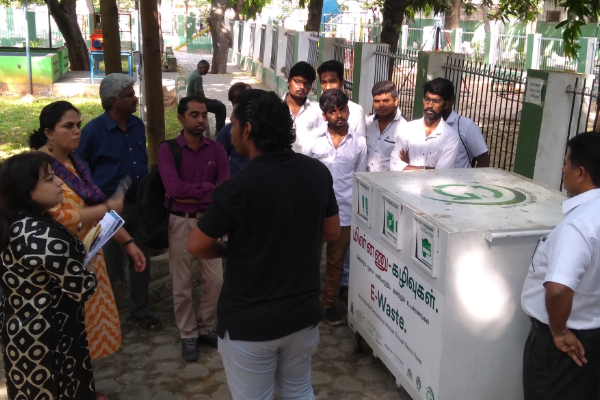
Coimbatore generates around 10 TPD of e-waste and the city’s efforts to better manage the informal e-waste was supported by CapaCITIES project.
Study found that the city corporation should set up a dedicated facility for collection, dismantling, recycling and safe disposal of E-waste on a PPP basis and an advertisement for expression of interest was floated in this regard.
Status: Report submitted in Phase1
Operations and Maintenance of micro compositing centres on PPP
Coimbatore City Municipal Corporation (CCMC) was mandated by the National Green Tribunal (NGT) to construct Micro-composting centers (MCCs) in various wards of the city.
CapaCITIES project assessed the operational viability of 6 Micro-composting Centers (MCCs) based on PPP model for replication in other wards across the city. The bankability study found the model to be viable with several complementary benefits to the city.
Status: Report submitted in Phase1
200 tons organic waste to bio CNG plant on Public Private Partnership

Coimbatore: ~40% of the total waste generated by the Coimbatore city is dumped in a mixed waste landfill at Vellalore.
The project is supporting development of 200 tons waste to Bio CNG facility to process the organic waste on PPP. By reducing the organic waste dumped at the mixed landfill the project is expected to ~0.38 mil tco2e annually and mobilize ~ EUR 8-9 mil. private investment in the city.
Status: Phase 2 – Under Progress
Technical Assistance
Solutions and for the Scientific Closure of Tithardi Dumpsite

Udaipur: Assessing the non-operational Tithardi dumpsite with mixed waste, revealed that there was no active landfill gas emissions from the dumpsite and waste characterization revealed mostly inert waste presence.
Therefore, an appropriate landfill closure method was developed and corresponding tender specifications were also proposed to the city. Accordingly, a tender for the closure of this dumpsite was notified by the Udaipur Municipal Corporation.
Status: Completed in Phase 1
Holistic Solid Waste Management Strategy for City for 2035

Coimbatore: CapaCITIES project developed a Long-term SWM Strategy for the City as a holistic internal planning and monitoring document for the Coimbatore City Municipal Corporation to reduce GHG emissions from the solid waste management sector through better treatment and scientific disposal of waste.
Status: Completed in Phase 1
Developed a plan for movement of solid waste to the existing dumpsite

Coimbatore: The engineering plan for movement of waste from multiple dumps in Vellalore to the old dumpsite was developed, allowing for its scientific closure, thereby reducing GHG emissions. The city had submitted this plan to the National Green Tribunal.
Status: Completed in Phase 1

Rajkot: Baseline assessment and analysis was carried out to develop a comprehensive implementation/action plan which considers the impact of the choices of technology for waste management on GHG emissions from the waste sector, in order to ensure climate sensitive solid waste management in the City.
Status: Completed in Phase 1