
CapaCITIES Project Cities Breathe Easy as AQI Falls during Lockdown
Key actions by local governments aid air quality improvement
The importance of urban air quality has probably never been more keenly felt than during the national lockdown in the past few months, when ceasing of economic activities and the reduced use of fossil fuels led to the dawning of bluer skies.
To get a sense of the existing air quality in cities and with an aim to inform clean air action plans in cities, ICLEI South Asia conducted an assessment of the ambient air quality in the cities of Coimbatore, Rajkot, Siliguri and Udaipur in the July 2019-june 2020 period. These cities have installed air quality monitoring devices and sensors, aided by the Capacity Building for Low-Carbon and Climate-Resilient City Development in India (CapaCITIES) phase 1 project, which is supported by the Swiss Agency for Development and Cooperation (SDC), in addition to assistance from the Government of India’s Smart City Mission for three of them.
The data was collected from sensor based Ambient Air Quality Monitoring Stations (AAQMS) installed in the four cities. The hourly readings from the AAQMS have been used to calculate the daily air quality index (AQI) and other pollutant concentrations. The average daily data of individual AAQMS have been used to arrive at the monthly average of AQI, SOx and NOx levels. There is no data for certain days primarily due to calibration and other operational issues of sensors. There might be data variation caused by temperature inversion during winter, the COVID-19 lockdown from March 2020 to June 2020 and also the shifting of AAQMS to new locations in some cases.
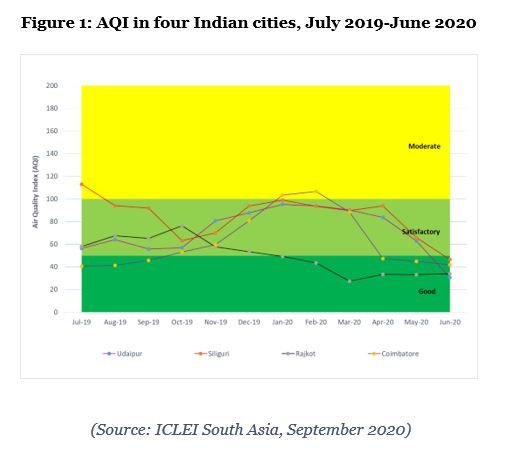
The monthly comparison of the average AQI values shows a clear incremental trend in Siliguri, Udaipur and Coimbatore between October 2019 and January 2020, mainly due to the onset of winter. During this period, the dispersion of pollutants was limited due to temperature inversion, resulting in a longer stay of pollutants in the atmosphere. The major sectors contributing to air pollution are transport, industry and construction, besides factors such as burning of biomass and refuse and re-suspension of road dust.
The highest NOX concentration levels among the four cities have been observed in Siliguri, followed by Udaipur, Coimbatore and Rajkot. The SOx concentration levels were the highest in Udaipur, followed by Coimbatore, Siliguri and Rajkot. This can be attributed to the high rate of urbanisation and economic activities, which lead to the use of fossil fuels by private and commercial vehicles, small and medium industries and diesel generator sets for electricity production.
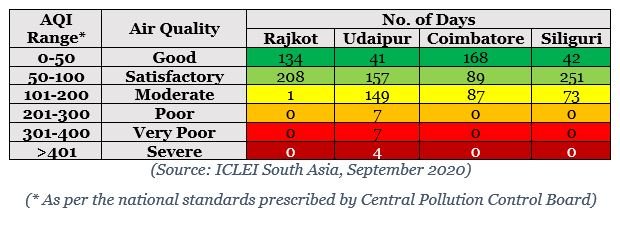
The data from Udaipur reveals a 45% drop in the monthly AQI levels between July 2019 and June 2020. However, on 18 days, the AQI level was in the ‘poor’ category and beyond, i.e. above 200 (as per national AQI standards set by the Central Pollution Control Board), while on 41 days, the AQI was reportedly under 50 (in the ‘good’ category). Similar reductions were observed for other pollutants such as PM2.5, PM10, SOx and NOx in the city. However, the SOx and NOx levels breached the 80 μg/m3 (microgram per meter cube) safety level, as per CPCB standards, on 230 and 62 days, respectively.
In Siliguri too, the air quality improved, with the AQI falling from 112 to 45 during the assessment period. However, there was only a slight drop in PM2.5 and PM10 concentration levels.
In Rajkot, the average monthly AQI fell 41% in the period, while the monthly NOx and SOx concentration levels dived 54% and 48%, respectively. The air quality remained good, with only one day falling under the ‘moderate AQI’ category.
Coimbatore enjoyed six months of good air quality, with the average monthly AQI staying under 50; there were three months of ‘moderate’ average AQI levels. The air quality remained in the ‘moderate’ 100-200 category on 87 days, while on 168 days, it was below 50 in the ‘good’ category.
Table 1: Day-Wise AQI in CapaCITIES-1 Cities, July 2019-June 2020
 All these cities have been at the forefront of taking policy action and implementation of projects to monitor and curb the rising rate of air pollution. Some of the key activities include installation of sensor-based ambient air quality monitoring stations, promotion of non-motorised transport, deployment of electric vehicles, scientific closure of dumping and landfill sites, creation of no-vehicle zones and strategic interventions in urban redesigning. More specifically, these actions include:
- Creation of no-vehicle zones in high pedestrian traffic areas and making strategic interventions in redesigning of streets in Udaipur
- Installation of Real-time Continuous Ambient Air Quality Monitoring Systems (CAAQMS) under National Clean Air Action Plan at Ashok Nagar, Udaipur
- Scientific closure of three dumping areas in Diva Khardi area through caping method and plantation through social forestry in Udaipur
- Preparation of an action plan by the Udaipur Municipal Corporation under the National Clean Air Programme (NCAP), initiated by the Union Ministry of Environment, Forest and Climate Change (MoEFCC), with the help of data generated by AAQMS sensors
- Deployment of 50 electric buses by the Rajkot Municipal Corporation (RMC) and promotion of cycle-sharing schemes to reduce the use of fossil fuels and consequent pollution
- Monitoring of air quality by the RMC at 20 locations and collection of data on temperature, humidity, CO2, O2, CO, SO2 and NOx. Sensor-based PM2.5 & PM10 monitors have been also installed under the SDC-funded CapaCITIES project at two locations in Rajkot
- Development of a 47-acre urban forest in Rajkot that will have more than 25,000 plants and trees of native species to help mitigate air pollution.